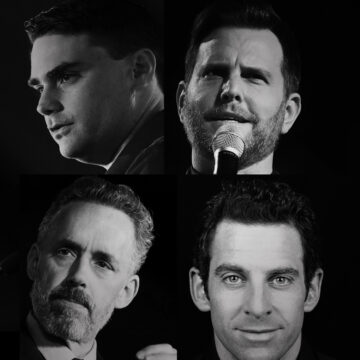
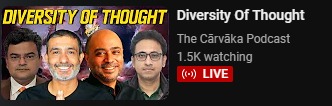
Sidestepping the fact that many of the IDW’s members have appeared on cable TV (as pundits no less), Rubin’s take aligns closely with Weinstein’s. He notes that an IDW member’s analysis on current events will often run counter to mainstream media’s take, particularly left-leaning outlets. There are entire cities to sack in the bad arguments and sometimes downright embarrassing claims made by the IDW’s would-be militants for reason and, in this respect, Brooks certainly doesn’t hold back his contempt. Dave Rubin in particular (“mind-blowingly insipid,” “dumb as a rock”) provides ample fodder. As Michael Brooks observes in the opening chapter of his new book Against the Web, the contradiction is hardly a new one. Reactionary figures, after all, have projected a narrative of cultural victimhood going back to the earliest days of William F. Buckley Jr and the National Review.
Today’s Left Needs To Learn From Christopher Hitchens
These sorts of claims are once again continuous with the decades-old conservative campaign against political correctness. Neoconservatives of the 1980s and 1990s did not always make the same appeals to statistical certainty. Conservatives have tended to view democracy as a system that establishes equal rules for competition between private individuals; while liberals, progressives, and even many radicals have typically shared this view, the American left has historically supported interventions to guard against excessive inequality. During the campus wars at the end of the 20th century, “political correctness” joined the conservative conceptual arsenal to describe and fight against the left’s support for “equal outcomes” (it is perhaps no coincidence that this new term arose just as the Soviet Union was beginning to crumble). The 1980s–1990s political correctness debates were in many respects debates over the legacy of the radical politics and counterculture of the 1960s. Allan Bloom kicked things off with his 1987 best seller The Closing of the American Mind, which argued that the influence of ’60s-era student, feminist, and Black Power movements led college students to reject traditional liberal arts curricula.
While some connections are straightforward, like the use of positive words indicating happiness, such as “happy,” “excited,” and “elated,” many relationships between verbal expression and psychology are less apparent. For instance, higher social standing and confidence are linked to elevated use of “you” words and reduced use of “me” words. LIWC relies on decades of empirical research and provides specialized means to comprehend, elucidate, and quantify psychological, social, and behavioral phenomena. Finally, although Perspective’s implementation is not open-source, their team has released information on how the current system was trained and deployed, including the pretraining of the model (Lees et al. 2022). That day, critics of the figures profiled in the op-ed posted tweets mocking and deriding the article (shown below).
The Intellectual Dark Web: A History (and Possible Future)

In some versions of this refrain, the dark web goes further than the neoconservatives of decades past, whose paeans to traditional college curricula often had little implications outside the campus walls. Intellectual Dark Web (IDW) is a phrase coined by mathematician Eric Weinstein referring to a loosely defined group of intellectuals, academics, political commentators who espouse controversial ideas and beliefs surrounding subjects related to free speech, identity politics and biology. In early May 2018, a New York Times op-ed written by staff editor Bari Weiss titled “Meet the Renegades of the Intellectual Dark Web” drew polarized reactions on social media. Since then, Peterson’s abrasive advice and abstruse theorizing in the realms of psychology, evolution, ethics, religion and myth have attracted huge swaths of followers.
The Reason Memes Aren’t Good Anymore
In the 1990s, left and progressive thinkers including Richard Rorty, Cornel West, and Edward Said made clear their reservations about certain activist tactics, and articulated positions in line with the same universalist values neoconservatives claimed as their own. Today, magazines like Current Affairs dedicate much of their content to debunking the claims of dark web figures while also addressing the limited effectiveness of “social justice warrior” politics. Treating the beliefs of the dark web as politically conservative views, rather than a sort of transpolitical meta-position — that is to say one critique of political correctness among others, albeit an extreme one — could do much to bring these sorts of left alternatives into the public debate.
Welcome To The Counterfeit Times
Roberts’ book provides a compelling history and a thoughtful analysis of one of the most interesting cultural movements of our time. But if we fast-forward now, five years later, I think we have to make the argument that the IDW is a spent force. In some ways, like President Trump, it served an initial purpose to shake up the status quo.
Philippe Rushton, a race-obsessed researcher linked to the racialist Pioneer Fund and white nationalist New Century Foundation. We can’t search for truth through any other principle because that means we would have to afford special protections to those claiming offense. As soon as we do that, we elect authorities who decide what is offensive and what isn’t, and that is where the danger lies. How many times have we seen professors, student groups, and individuals punished for perceived offense determined by institutional authorities? Protecting the downtrodden might be considered a virtue, but overprotection is a vice. We are selectively choosing which arguments are ok to make by a cabal of politically correct youth, who claim to stand for the oppressed.
Harris thinks Rubin has changed, when really he’s just evolved into a more unapologetic version of the clout-chaser he was back when he was still in Harris’ favor. Indeed, it was Rubin’s obsequious flattery—now mostly reserved for MAGA and DeSantis stans—that made his show an attractive platform for people like Harris and the IDW in the first place. These movements can be hard to take seriously — Yuyencia’s website, for example, describes their proposed nation as having a “unique national language,” called Yenpolish, and a national religion, which will be Roman Catholicism. The only future for the people that live under an empire of fellaheen (fèilā dìguó 费拉帝国) is a process that he calls “ethnic invention” (mínzú fāmíng 民族发明) — basically, concoct a local Culture (capitalized after Spengler, who saw Culture as the seed and Civilization as the plant into which it grows).
Discover Content
TheIntellectual Dark Web sounds like a shady corner of the internet, a place to buy illicit David Foster Wallace novels or hook-up for a midnight rendezvous to discuss metamodernist urban planning. While the IDW certainly hosts its fair share of late-night bullshit sessions, it’s not as clandestine as its namesake,the dark web, suggests. At a brisk eighty-two pages, Against the Web manages to cover a lot of ground and doubles as a handy reference guide to the most popular reactionary figures of the present moment and their bestselling intellectual hokum. But it is also a timely warning about the dangers of reflexively dismissing their popularity, or surrendering their often confused and alienated audiences to the right. Underlying each is a simplistic story of a natural order corrupted, of objective truth obscured by a relativistically minded culture too afraid to face it.
New York Times Op-ed
- What they all share is not a general commitment to intellectual free exchange but a specific political hostility to “multiculturalism” and all that it entails.
- For example, last year, students called for the cancelling of “gender-critical feminist” Holly Lawford-Smith’s course on feminism at the University of Melbourne, due to her arguments for the significance of biological sex.
- To understand the unhappiness of dark web intellectuals, you have to go back in time.
- LIWC relies on decades of empirical research and provides specialized means to comprehend, elucidate, and quantify psychological, social, and behavioral phenomena.
- We can’t afford to change the rules of science just because some might take offense to objective findings.
Supports would point to Rubin’s remarks, noting the mainstream ignores conversations that are politically inconvenient. Meanwhile, as we’ve seen, opponents believe the IDW isn’t ignored by the mainstream; they simply aren’t viewed as an unassailable narrative driving force. But this only leads one to wonder whether membership is by invitation, request, or if the movement merely pulls public figures into its orbit like some trending black hole. Pinker has shared the stage with several IDW members but has never proclaimed himself a card-carrying member. Economist Glenn Loury and linguist John McWhorter aren’t mentioned in the article or on the website, but others have claimed they represent the “black wing” of the IDW.
Social Media Links
Complaints about a stifling and censorious climate of political correctness are also far from a novel development. Nonetheless, as Brooks argues, the so-called IDW still represents something more than just garden-variety cultural conservatism even if the two share plenty of terrain. The fascist movement in the Republican party has turned to critical race theory instead. Fascism feeds off a narrative of supposed national humiliation by internal enemies. Defending a fictional glorious and virtuous national past, and presenting its enemies as deviously maligning the nation to its children, is a classic fascist strategy to stoke fury and resentment.
Being a conservative rather than a reactionary, Roosevelt’s former general, Dwight Eisenhower, reconciled with social welfare state and promoted integration once he won the presidency back for Republicans in 1953. But his approach was despised by a group of young reactionaries who aimed to completely eradicate all “communistic” welfare programs, protect segregation, and install an explicitly Christian supremacist government. Three of the most prominent leaders of this faction were National Review creator William F. Buckley Jr.; Robert Welch, founder of the John Birch Society; and Leo Bozell Jr., Buckley’s brother-in-law, coauthor, and sometime business partner. Just over six years ago, the New York Times published a splashy essay by staff editor and writer Bari Weiss hailing an “alliance of heretics” called the “Intellectual Dark Web” whose members supposedly existed apart from the traditional left and right political spectrum.
Postmodernism, ‘woke’ And Disputed Realities
After a failed trial run in 1976 Republican against then-president Gerald Ford, Reagan won the party nomination and the presidency in 1980 and again in 1984. Likewise, it’s unclear that Weiss and her predecessor, James Atlas, were aware that they were being used in a process that had already repeated itself several times before the late nineties. As for the larger group, conspiracy theorizing was always a key plank in the Intellectual Dark Web’s branding (I mean, just say the name out loud and you’ll sound like you need to go touch some grass). It’s hardly surprising that many of the people who embraced such a label would drift so quickly into a version of Alex Jones with a thesaurus. Harris demurred, saying most of the people he’s now embarrassed by are IDW-adjacent figures he says he’s never met (or maybe met once).